CRDTs
Design intent
Section titled “Design intent”Peerborne does not implement its own CRDT. It adapts existing, well-tested CRDT libraries — Yjs and Automerge — wrapping them with encryption, signing, access control, and peer-to-peer transport. The application interacts with Yjs shared types or Automerge documents directly. Peerborne handles everything else.
The goal: merge edits from multiple peers without a central consensus service, a lock manager, or a leader election protocol. No server assigns a global write order. Two peers editing concurrently produce a deterministic merged result.
Implemented model
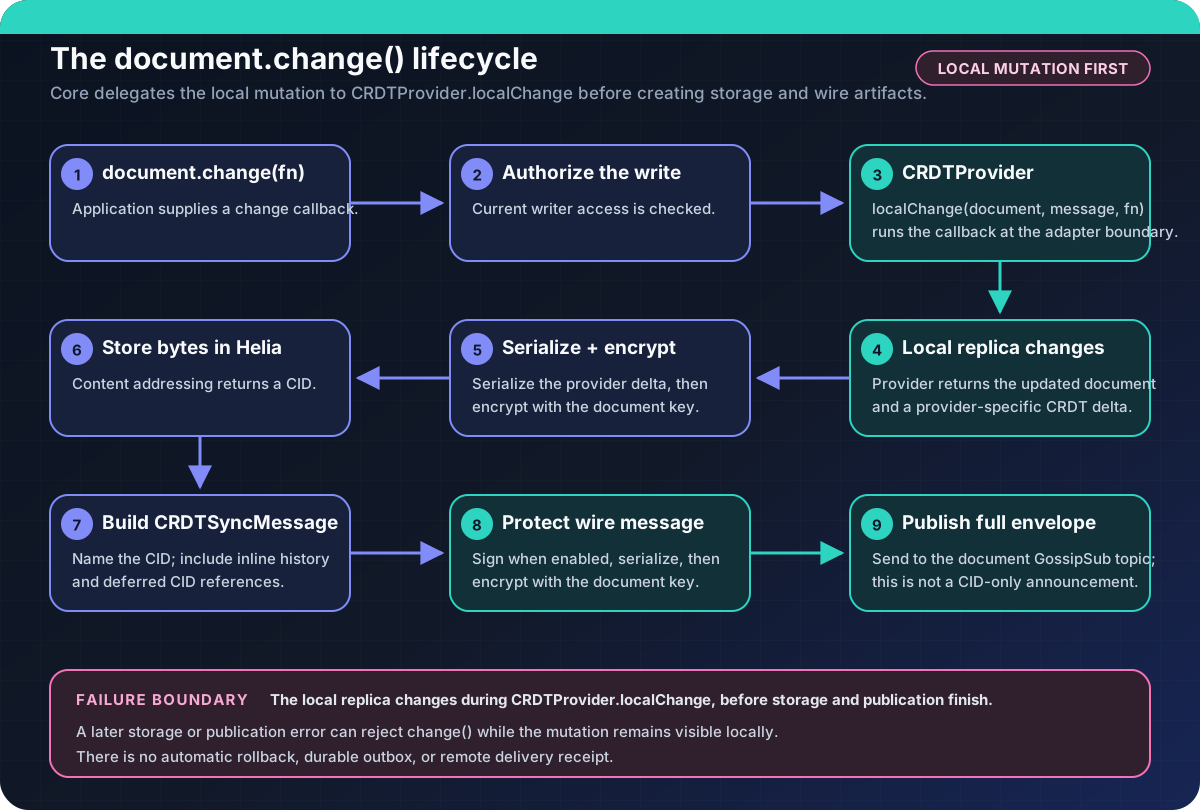
Section titled “Implemented model”The document.change() lifecycle
Section titled “The document.change() lifecycle”const todos = swarm.doc('/todo-list');await todos.create();
await todos.change((state) => { state.getArray<string>('items').push(['buy milk']);});Each document.change() call creates a CID-addressed stored payload and a
separate wire message:
Fit diagram to page
The shadow sync graph
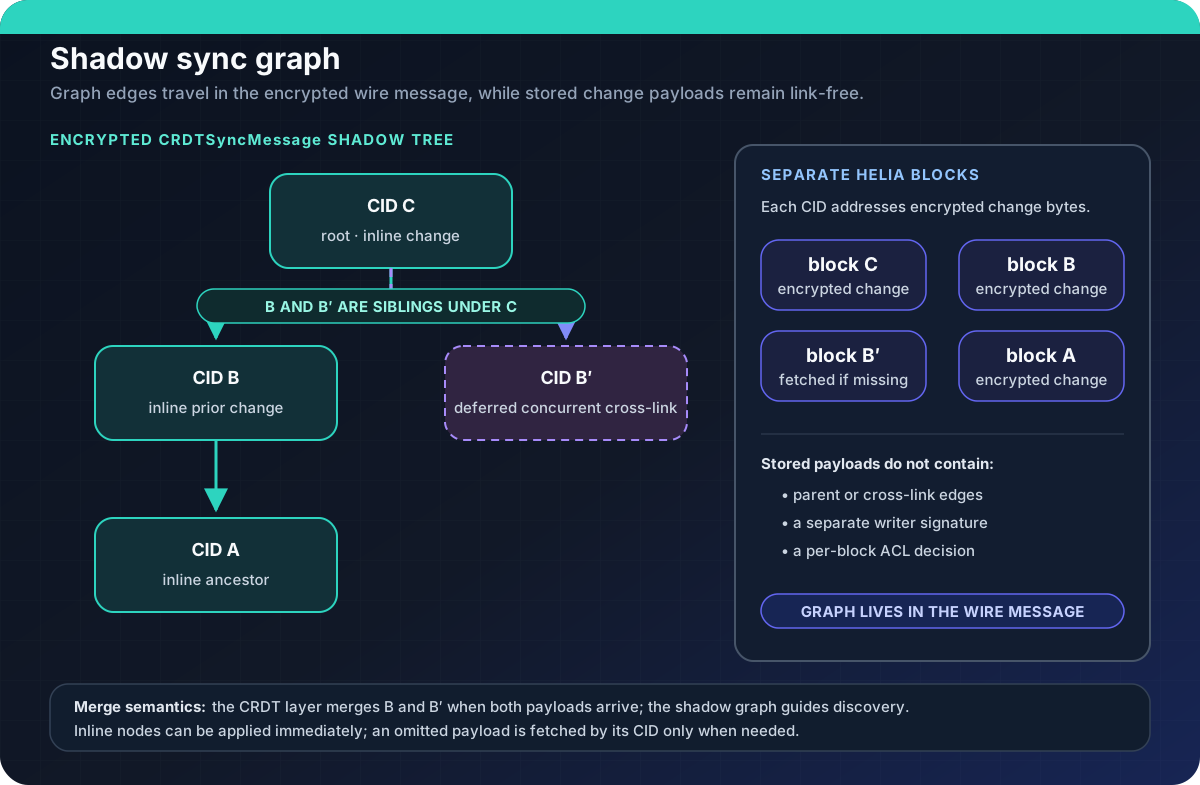
Section titled “The shadow sync graph”Peerborne does not put graph links inside each stored change payload. Instead,
the separately exchanged CRDTSyncMessage carries a shadow sync graph whose
node keys are CIDs:
Fit diagram to page
This means:
- Child-map keys in the wire tree reference prior or concurrent change CIDs
- The CRDT layer resolves concurrent edits (e.g., Yjs merges Y.Map updates from two peers)
- Stored ciphertext is immutable under its CID; later messages can reference it without rewriting it
- The implementation tracks a tip-set (multiple concurrent heads), computing a combined tip-set hash
- Receivers apply inline tree content and fetch only missing or deferred stored payloads
- The shadow graph is used for synchronization, not for application data modeling
CRDTProvider interface
Section titled “CRDTProvider interface”The CRDTProvider interface abstracts the CRDT library from Peerborne’s core:
interface CRDTProvider<DocType, ChangesType, ChangeFnType> { newDocument(): DocType; localChange( document: DocType, message: string, changeFn: ChangeFnType, ): [DocType, ChangesType]; remoteChange(document: DocType, changes: ChangesType): DocType; getHistory(document: DocType): ChangesType; getSnapshot?(document: DocType): ChangesType; applySnapshot?(document: DocType, snapshot: ChangesType): DocType;}Four required methods (newDocument, localChange, remoteChange, getHistory)
and two optional snapshot methods.
Two implementations exist:
- YjsProvider — wraps Yjs
Doc,Y.encodeStateAsUpdate,Y.applyUpdate,Y.encodeStateVector,Y.diffUpdate - AutomergeProvider — wraps Automerge
Doc,Automerge.save,Automerge.loadIncremental,Automerge.getLastLocalChange
Yjs semantics
Section titled “Yjs semantics”Yjs provides shared types that merge deterministically:
// Y.Map: deterministic per-key conflict resolutionconst ymap = state.getMap('settings');ymap.set('theme', 'dark');
// Y.Array: concurrent insertions preservedconst yarray = state.getArray('items');yarray.insert(0, ['first']);
// Y.Text: concurrent character insertions mergedconst ytext = state.getText('content');ytext.insert(0, 'Hello');
See the Yjs schema design cookbook for merge behavior tables, ID patterns, and current-schema validation.
Automerge semantics
Section titled “Automerge semantics”Automerge provides a JSON-like CRDT document model:
// Automerge: concurrent field updates mergedstate.title = 'New title';
// Automerge: concurrent list insertions preservedstate.items.push({ text: 'buy milk', done: false });
// Automerge: Text type for rich textstate.content = new Automerge.Text('Hello');
Convergence boundaries
Section titled “Convergence boundaries”Peerborne does not provide:
- Agreement-right-now. Two peers editing concurrently will see different states until they exchange updates. There is no real-time synchronization lock.
- Conflict-free in the database sense. CRDTs resolve structural conflicts (concurrent edits to the same field), but application-level conflicts (e.g., two peers setting a title to different values) are handled by the CRDT’s merge rule, not by application logic.
- Guaranteed delivery. Updates are published via GossipSub but not acknowledged. A peer that goes offline before publishing may lose updates.
- Convergence under partition. If a peer is partitioned for a long time, its replica diverges. When the partition heals, the CRDT merges. But if the local blocks are lost (e.g., IndexedDB cleared), convergence may fail.
Snapshots and compaction
Section titled “Snapshots and compaction”Snapshots
Section titled “Snapshots”Automatic snapshots are off by default. A writer can create a full-state snapshot, signed when signing is enabled (the signature field is empty otherwise):
await document.snapshot();A snapshot contains the complete CRDT state at that point plus boundary metadata, which is signed when signing is enabled. It is carried inside an encrypted load or snapshot-load response rather than stored as a CID-addressed Helia change payload. A peer that can authenticate and apply it can avoid replaying the entire change history.
Compaction
Section titled “Compaction”Automatic compaction is off by default. When enabled, configured change-count
thresholds call snapshot() and may prune older nodes from the in-memory shadow
tree. This does not delete stored block bytes unless opt-in gcAfterPrune is
also enabled. In particular:
- In-memory pruning can limit the history included in later sync messages
- Opt-in block GC deletes eligible local copies, so recovery then depends on another provider
- A quorum-bound first load rejects a snapshot-only response because it lacks a prior writer set for snapshot authentication
- Applications can call
snapshot()manually even when automatic compaction is disabled
Quorum loading
Section titled “Quorum loading”V4 initial loads require trusted signing authorities, a locally captured control/group tuple, and a fresh request challenge. The optional quorum gate requires Q distinct authenticated authorities to agree on a complete response digest covering the served graph, state, and frontier. An explicit Q is never lowered. Multiple PeerIds sharing one signing credential count once; the application must still establish independent trusted authorities. See security for the trust configuration and remaining limits.
CI-backed evidence
Section titled “CI-backed evidence”Verified in CI:
- Document creation, mutation, and retrieval in a single browser
- Yjs and Automerge provider initialization
- Encrypted existing-history retrieval through Circuit Relay
- Cross-NAT document retrieval with Docker-backed topologies
- Snapshot, compaction, and blockstore-GC behavior in focused suites
- Initial-load quorum decisions and orchestration in focused suites
Not verified:
- Multi-peer concurrent editing and convergence under partition
- Snapshot bootstrap across real peers
- Conflicting real peers serving adversarial shadow trees during quorum loading
- Long-running multi-peer compaction and GC followed by recovery
Next steps
Section titled “Next steps”- Yjs schema design — patterns for modeling data with Yjs shared types
- Security model — how signing, encryption, and ACL interact with the CRDT layer