
Local-first design
Design intent
Section titled “Design intent”A local-first application stores its primary data on the user’s device — not on a remote server. Changes apply to the local replica immediately, with zero network latency. The network is used to sync state between peers, not to enforce a global write order.
Peerborne adopts these local-first principles:
- Local replica near the user. The application reads and writes a local CRDT document. There is no server round-trip for reads or writes.
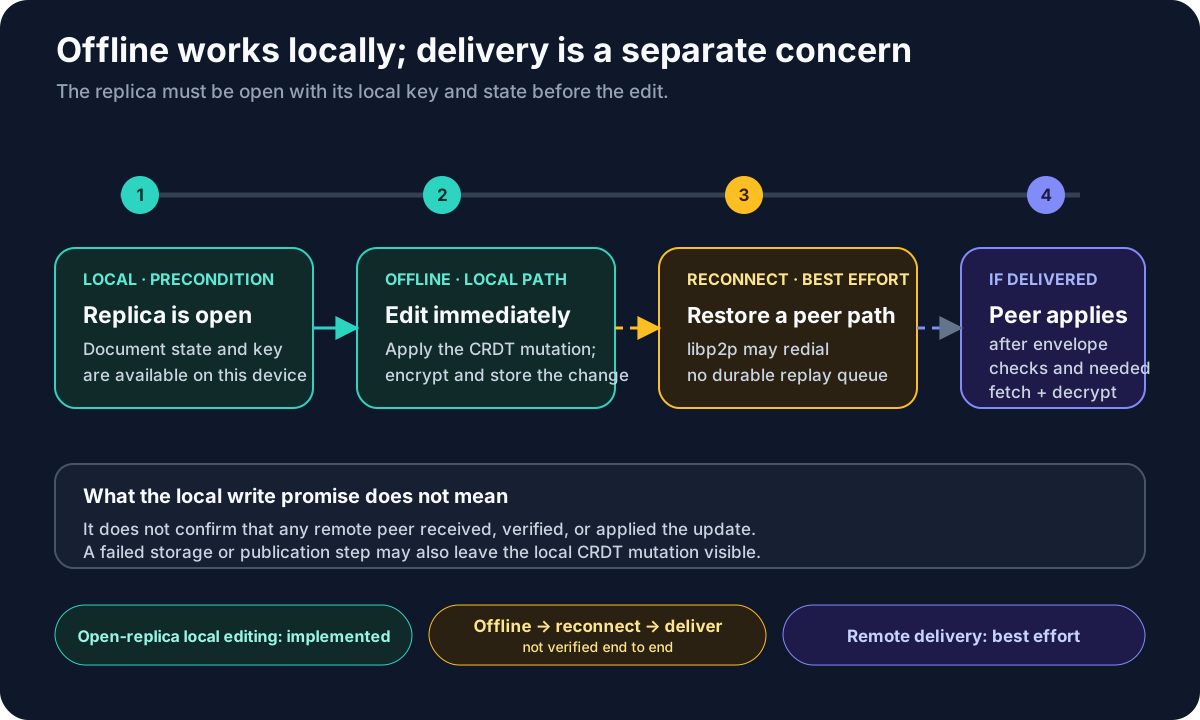
- Work offline. Once a replica is open—including a new local document—it can be edited without network access. Changes are applied immediately to the CRDT and stored locally in IndexedDB.
- No server-ordained write ordering. Two peers can edit the same document concurrently. The CRDT layer merges their changes when they eventually exchange updates.
- Eventually consistent. When peers reconnect, they may discover and fetch blocks that were created during the offline period. Delivery is not guaranteed — see limitations below.
Fit diagram to page
Evidence boundary: open-replica editing and local storage are implemented. The complete offline edit → reconnect → remote delivery sequence is not verified end to end. Libp2p may redial keep-alive peers, but Peerborne supplies no durable outbox, delivery receipt, or guarantee that a connection is restored and missed announcements are replayed.
What is implemented today
Section titled “What is implemented today”Offline editing (open local replicas)
Section titled “Offline editing (open local replicas)”An open Peerborne document with its local state and key material available can
be edited offline. This includes a new document created locally without a peer
connection. The document.change() call applies the mutation to the local Yjs
or Automerge replica immediately. Its promise covers storing an encrypted
change payload, building and optionally signing a separate sync message,
encrypting that message, and attempting publication through GossipSub.
await todos.change((state) => { state.getArray<string>('items').push(['buy milk']);});The encrypted change payload is stored before publication is attempted, so it can remain in local IndexedDB even if publication later fails. Libp2p may restore some peer connections, but missed-update replay and delivery are not guaranteed.
What change() covers
Section titled “What change() covers”The document.change() promise resolves when:
- The CRDT provider has applied the mutation to the local replica
- The change payload has been serialized and encrypted with the document key (AES-GCM by default)
- The ciphertext has been stored in the local Helia blockstore, producing its CID
- A separate
CRDTSyncMessagehas been built with that CID, inline history, and any deferred CID references - The complete sync message has been signed when signing is enabled, then serialized and encrypted with the document key (AES-GCM by default)
- Publication of the full encrypted sync envelope through GossipSub has completed
If storage or publication fails (e.g., IndexedDB quota exceeded, network error), the CRDT mutation may already be applied. The CRDT state reflects the mutation even if the remote sync path failed. There is no automatic rollback.
What is not yet implemented
Section titled “What is not yet implemented”No durable outbox
Section titled “No durable outbox”If a peer is unreachable when change() publishes to GossipSub, the update may not reach them. Peerborne does not persist a queue of outgoing changes to retry later. There is no delivery acknowledgment or guaranteed-at-least-once semantics.
No delivery acknowledgment
Section titled “No delivery acknowledgment”When a change is published, there is no confirmation that remote peers received, verified, or applied it. The application must implement its own acknowledgment protocol if it needs delivery guarantees.
No durable reconnect-and-replay guarantee
Section titled “No durable reconnect-and-replay guarantee”Libp2p can redial peers tagged for keep-alive, including relay reservation paths. Peerborne does not provide a durable reconnection/outbox protocol that guarantees connection restoration or replays announcements missed while a peer was offline. Applications that require recovery must observe connectivity and coordinate their own retry, resynchronization, or acknowledgment flow. See the networking page for transport details.
No close/restart recovery verified in CI
Section titled “No close/restart recovery verified in CI”Documents store encrypted blocks in browser IndexedDB via Helia’s blockstore. Local persistence works in single-session tests, but complete browser close → reopen → verify document state has not been proven in CI. See the roadmap for current status.
Automerge/Yjs mutation persistence on rejection
Section titled “Automerge/Yjs mutation persistence on rejection”If part of the change() pipeline fails (e.g., storage quota exceeded), the CRDT mutation may already be applied to the local replica. The mutation persists locally even though the remote sync failed. There is no automatic undo or rollback of the CRDT state.
The infrastructure boundary
Section titled “The infrastructure boundary”“Local-first” does not mean “infrastructure-free.” Browser nodes do not bind
ordinary inbound TCP sockets. Peerborne’s browser default nevertheless
advertises circuit-relay, WebRTC, and WebSocket listen addresses and enables
WebRTC, WebRTC Direct, WebTransport, and relay transports. Bootstrap discovery
is optional: without a configured bootstrap peer or an explicit connect()
address, the default node remains a swarm of one. The current cross-NAT
Peerborne acceptance test explicitly dials a Circuit Relay address; direct
WebRTC/WebTransport document sync and DHT behavior remain unverified.
Depending on the deployment topology, supporting infrastructure can include:
- Relay nodes to bridge NAT for browser peers
- Bootstrap nodes as well-known entry points for the libp2p network
- STUN/TURN servers for WebRTC hole-punching (optional, for direct peer connections)
A relay that does not hold the document key forwards ciphertext; bootstrap and STUN provide discovery or address metadata rather than document plaintext. Infrastructure components can still observe network metadata, and any component that is also enrolled as an authorized document peer can decrypt according to its keys.
See running a relay for the development relay setup.
What local-first Peerborne is a good fit for
Section titled “What local-first Peerborne is a good fit for”Peerborne’s local-first model works well for:
- Small collaborative documents (todos, notes, wikis, password vaults) where the document fits in a single CRDT replica
- Applications that own identity and recovery — Peerborne does not provide authentication or key recovery
- Deployments where you control the relay infrastructure — there is no cloud service to delegate to
- Experiments and prototypes learning about local-first architecture
It is not a good fit for:
- Large datasets (hundreds of megabytes per document)
- Applications that need SQL or relational queries
- Production systems requiring guaranteed delivery and durability
- Applications expecting a managed backend service
CI-backed evidence
Section titled “CI-backed evidence”These behaviors are verified by CI:
- Document creation, local mutation, and retrieval in a single browser session
- Encrypted existing-history retrieval through Circuit Relay
- Automerge and Yjs provider initialization and basic operation
- Crypto operations (signing, encryption, key generation)
These behaviors are not verified:
- Browser restart and document recovery
- Multi-session persistence across browser closes
- Offline editing with later reconnection and delivery
- Guaranteed transport reconnection and missed-update replay
Next steps
Section titled “Next steps”- Architecture — data flow and system structure
- CRDT model — how Yjs and Automerge integrate
- Limitations — complete list of current gaps