
Performance
Peerborne makes several deliberate performance tradeoffs to balance security, consistency, and resource use. This page documents the design decisions, benchmark suites, and tuning guidance.
Design decisions
Section titled “Design decisions”Load concurrency cap
Section titled “Load concurrency cap”On a quorum-bound full load, Peerborne strips inline changes, enumerates the
served change-tree CIDs, and drains at most eight concurrent Helia
blockstore.get() calls before invoking sync(). Successful gets may populate
the local blockstore; the gate precedes CRDT/ACL mutation, not every local
storage write. The same eight-worker cap also bounds the hash-only block
prefetch of tracked bootstrap and invitation catch-up loads (including
quorum-disabled loads) and the missing-block fetch pool during sync; only the
exhaustive prefetch after inline changes are stripped is quorum-specific.
Source: peerborne-document.ts — LOAD_PREFETCH_MAX_CONCURRENCY and the bounded worker pool for blockstore fetches.
Load quorum defaults
Section titled “Load quorum defaults”When enabled (the default), document open probes at most loadQuorumK distinct
currently connected peer IDs. Effective K is
min(loadQuorumK, deduplicatedConnectedPeerCount). With K ≥ 2, the default Q
is floor(K / 2) + 1; an explicit Q is a hard floor and is never reduced. Effective K = 1 is
rejected unless loadQuorumAllowSinglePeer is explicitly enabled.
Q distinct authenticated writer authorities must agree on a digest covering the locally trusted security tuple, document, served frontier, and complete response manifest. Peerborne binds the selected response to that digest and the fresh request challenge before mutation. Many transport PeerIds sharing one credential count once; independently controlled trusted authorities are still an application requirement:
| Parameter | Default | Rationale |
|---|---|---|
loadQuorumK | 3 | Caps the connected peers probed; fewer connected peers reduce effective K |
loadQuorumQ | Majority of effective K | floor(K / 2) + 1; an explicit value is never lowered |
loadQuorumTimeoutMs | 5000 | Per-peer timeout; peer probes run in parallel |
loadQuorumAllowSinglePeer | false | Requires an explicit opt-in before effective K = 1 can pass |
Source: peerborne-config.ts. Focused tests cover pure decisions and orchestration with mocked probes; they are not a hostile real-network quorum test.
Parallel deserialization
Section titled “Parallel deserialization”Both CRDT adapters use parallel deserialization for cold-cache performance to reduce time-to-interactive when opening large documents:
Revocation latency
Section titled “Revocation latency”Focused BeeKEM tests show that a removed reader’s leaf (blanked in the tree) cannot derive the root
produced by the corresponding PathUpdate. This avoids the primitive-level flaw
of encrypting a successor key under a predecessor key already known to the
removed reader. It is not an end-to-end revocation guarantee: PathUpdate
delivery is best-effort, BeeKEM state is memory-only, and multi-peer
partition/rejoin revocation is not verified. Source:
peerborne-document.ts
and wire-protocols.ts.
The removed-member cases in
beekem-revocation.test.ts
and the encoded-delivery cases in
beekem-revocation-wire.test.ts
provide the focused evidence for that primitive property.
GC and bounded caches
Section titled “GC and bounded caches”- LRU cache: Used for document change blocks and key material. Limits unbounded memory growth. Verified by
lru-cache.test.ts. - Compaction: Automatic snapshot triggering is disabled by default. A writer can still call
snapshot()manually when the CRDT provider supports snapshots. WithpruneAfterSnapshot, snapshot creation prunes the in-memory served sync tree while retaining recent document nodes and preserving ACL nodes. Helia block deletion remains off by default (gcAfterPrune: false); when enabled, eligible pruned-block deletion is scheduled asynchronously. Focused tests cover configuration and pruning/GC helper decisions; long-running concurrent multi-peer compaction is not exercised. - React hook caches: Module-level task and subscriber-count caches with ref-counting eviction. Verified by
hooks-cache.test.tsandhooks-lifecycle.test.ts.
Local index execution
Section titled “Local index execution”V2 memory indexes use sorted compound-key arrays with binary-search lookup; incremental insert/delete can still shift O(N) entries. IndexedDB uses compound secondary indexes and bounded cursors. Equality/range lookup visits the selected range, but first is not yet an early-termination guarantee and count: 'exact' exhausts all matches. Execution metadata reports rows visited and whether sorting stayed in index order. See the indexing design.
Benchmark suites
Section titled “Benchmark suites”Peerborne includes six benchmark suites across two packages. Each suite uses a statistical runner that reports min, max, mean, median, p99, and standard deviation with warmup iterations and optional memory-delta tracking.
The charts below are generated from the committed
benchmark-snapshot.json
snapshot. It was collected on Apple M5 hardware with 32 GB RAM, Node.js
22.19.0, and macOS arm64. Most points use 20 timed iterations; the convergence
suite uses four and the blind-index field series uses ten because those suites
intentionally reduce the requested count for their more expensive cases.
Treat the values as a directional, single-machine snapshot—not a performance guarantee or a comparison with other systems. The convergence chart is a local simulation, not a browser, relay, or wide-area network measurement. Dots show means and capped whiskers show p99. No chart establishes a pass/fail budget.
Core benchmarks
Section titled “Core benchmarks”Source: packages/core/src/__benchmarks__/
| Suite | File | What it measures |
|---|---|---|
| CRDT Sync Latency | crdt-sync-latency.ts | Per-operation latency of the change pipeline at payload sizes 1 KB to 1 MB: ECDSA P-384 sign/verify, AES-GCM encrypt/decrypt, combined sign+encrypt and decrypt+verify pipelines, JSON serialize/deserialize |
| Crypto Overhead | crypto-overhead.ts | Key generation cost (ECDSA P-384, AES-GCM-256), key rotation at 10 KB, plaintext vs encrypted change propagation across sizes, isolated crypto operation overhead |
| Convergence Simulation | convergence-simulation.ts | Simulated multi-peer convergence: 2–32 peers making concurrent edits through the full sign-encrypt-broadcast-decrypt-verify pipeline, measures time-to-convergence, message count, and bandwidth |
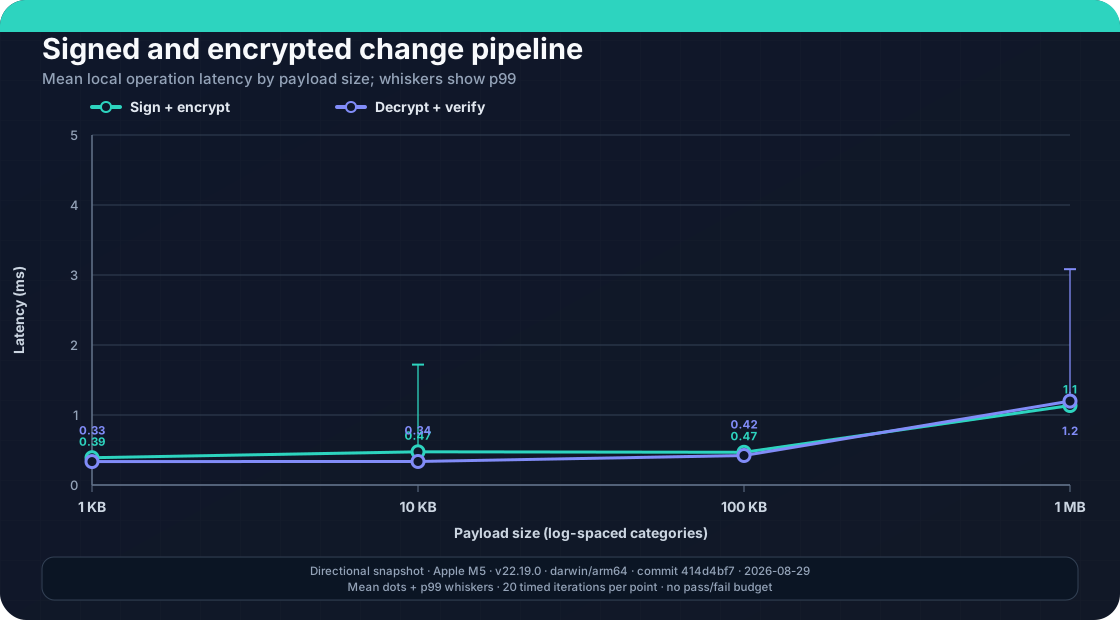
Fit chart to page
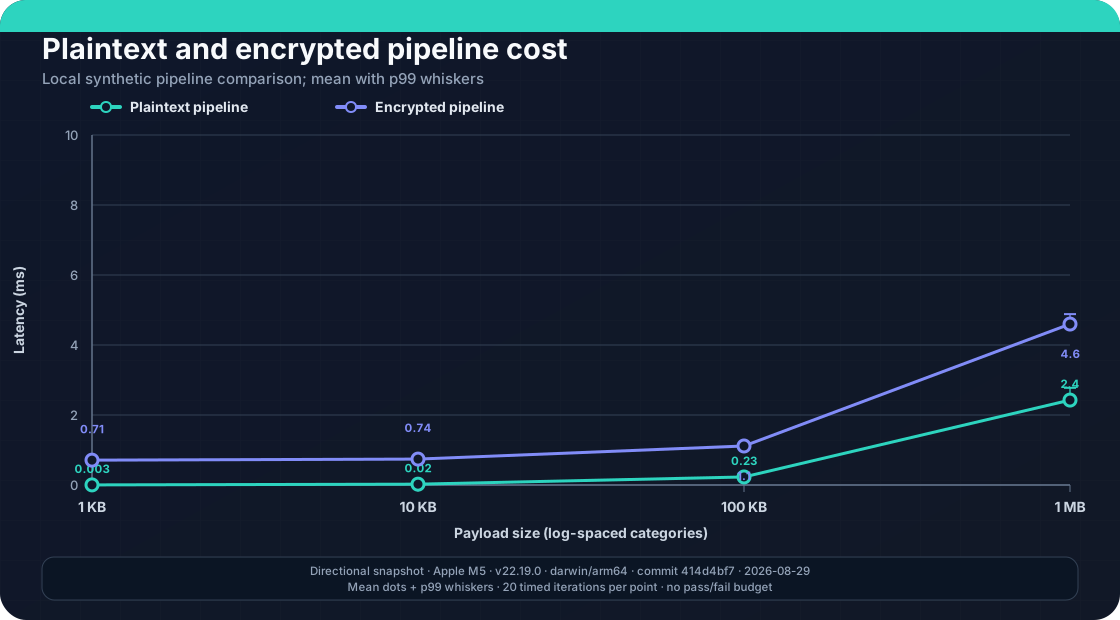
Fit chart to page
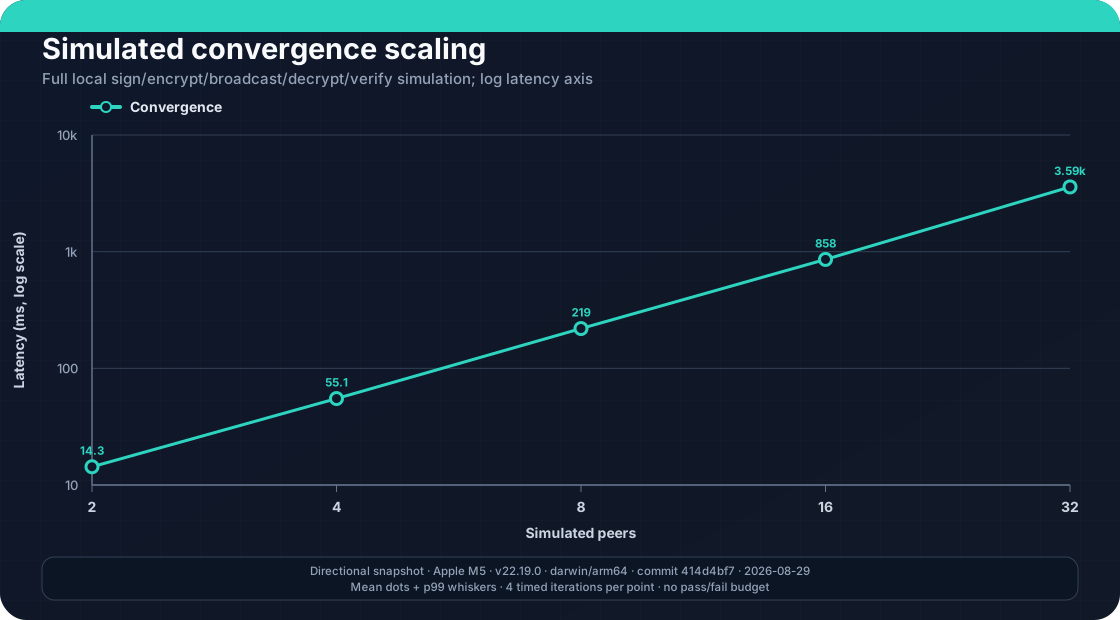
Fit chart to page
Index benchmarks
Section titled “Index benchmarks”Source: packages/index/src/__benchmarks__/
| Suite | File | What it measures |
|---|---|---|
| Index Query Scaling | index-query-scaling.ts | Query latency vs index size: 100–100K documents. Exact-match, range, prefix, compound, and sorted queries against MemoryIndexStorage, plus single-document update cost and full-scan baseline |
| Bloom Filter Scaling | bloom-filter-scaling.ts | Insert throughput at filter sizes 1K–1M bits, positive/negative query time, false-positive rate at fill counts 100–10K, serialization/deserialization time, CRDT merge (join) time, memory footprint |
| Blind Index Performance | blind-index-perf.ts | Encrypted search operations: field-key derivation (HKDF), single/compound token generation, token match/mismatch comparison, field-count scaling (1–16 fields), batch throughput (100 tokens) |
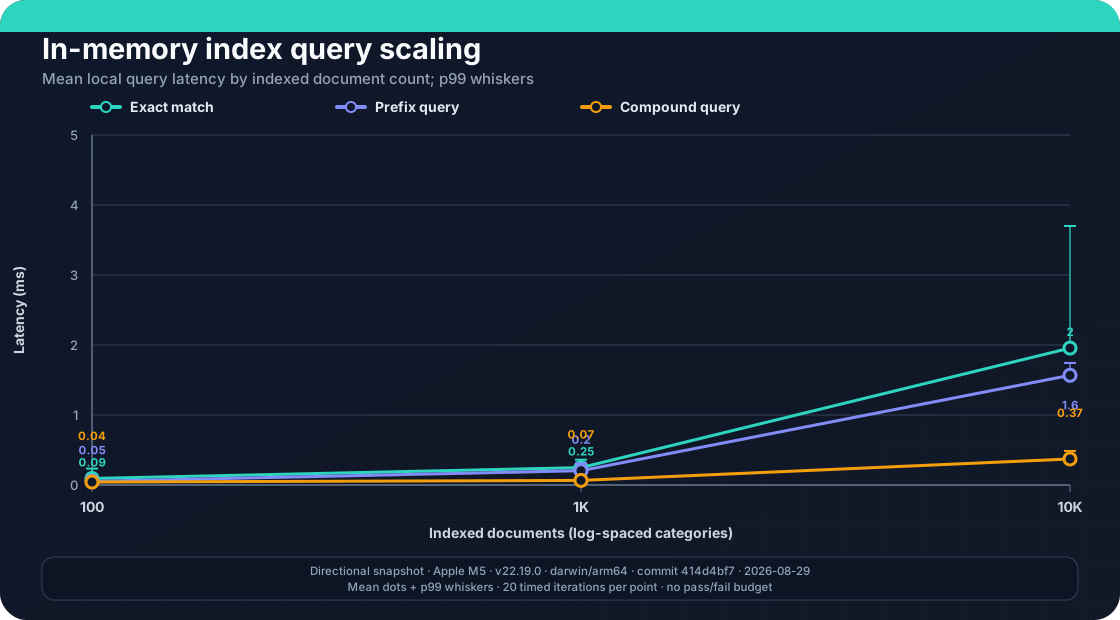
Fit chart to page
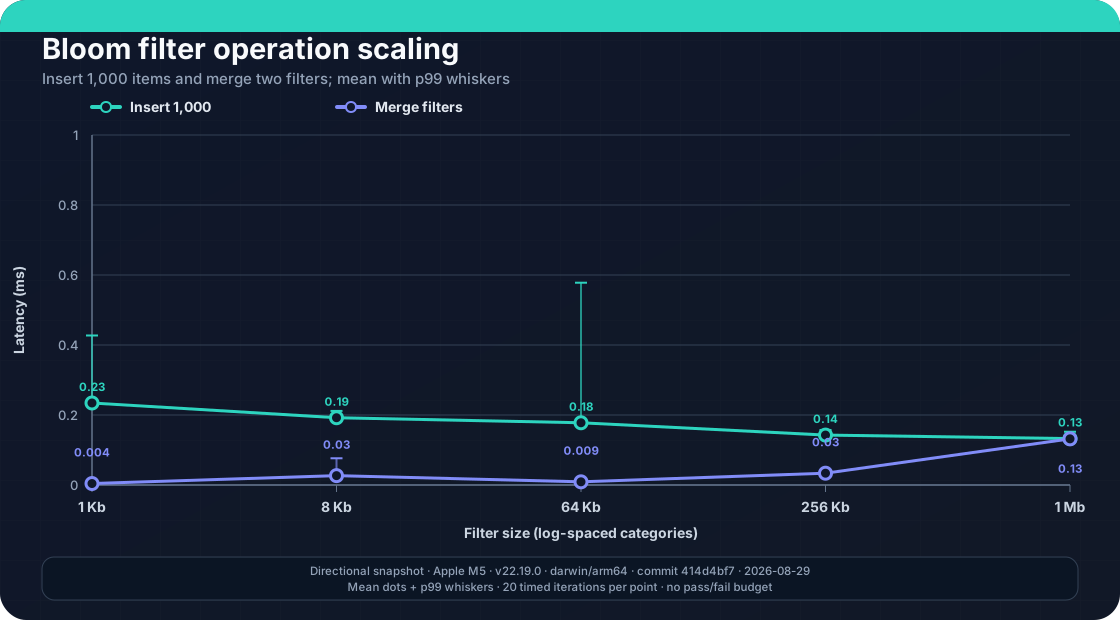
Fit chart to page
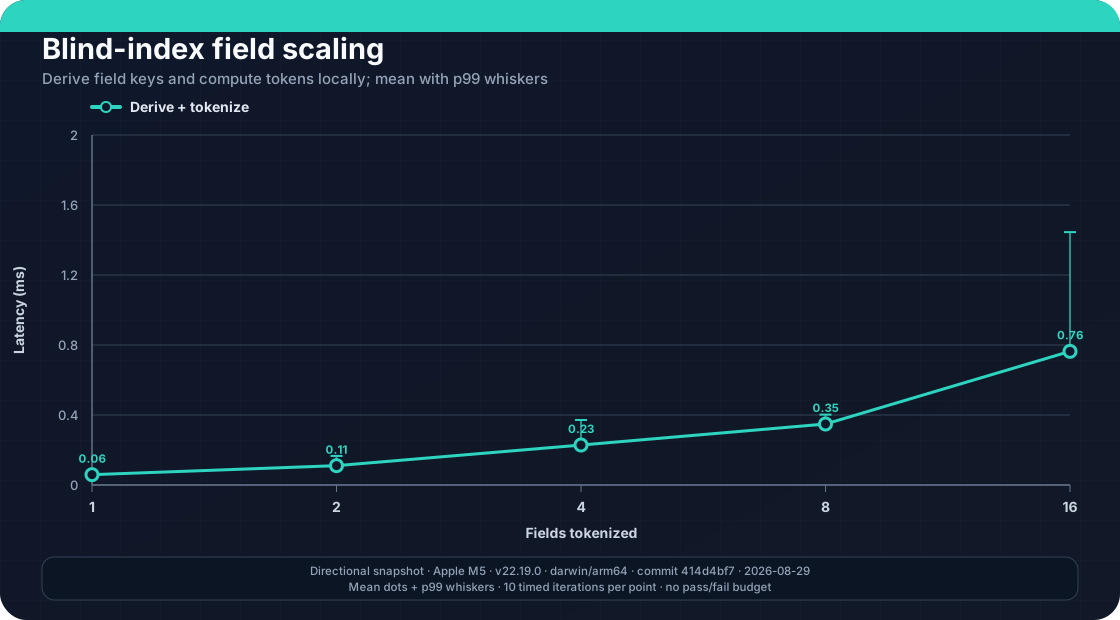
Fit chart to page
Performance-aware tests
Section titled “Performance-aware tests”Several test suites exercise performance-critical paths:
| Test suite | Path | What it covers |
|---|---|---|
| Load quorum | load-quorum.test.ts | Quorum decision logic, hash-binding comparison, config validation |
| Load quorum orchestrator | load-quorum-orchestrator.test.ts | Multi-peer quorum scenarios including timeout and insufficient-response paths |
| LRU cache | lru-cache.test.ts | Eviction correctness, capacity bounds, size tracking |
| Blockstore GC | blockstore-gc.test.ts | CID collection, deletable-filtering, tree-shape coverage |
| Compaction | compaction.test.ts | Config defaults, GC decision logic, prune+GC integration |
| Network statistics | network-stats.test.ts | Message/byte counters, connection tracking, snapshot isolation |
| React hook caches | hooks-cache.test.ts and hooks-lifecycle.test.ts | Cache population, ref-counted eviction, per-document isolation |
| Cross-NAT throughput | nat-resilience.spec.ts | 10-message bidirectional burst across NAT boundaries with delivery threshold |
Document size guidance
Section titled “Document size guidance”- ~1 MB threshold: Consider splitting documents when encoded state exceeds ~1 MB. Decoding and encoding cost degrades with very large documents.
- Browser limits: Tens of MB may cause performance issues in browsers.
- Tombstone accumulation: Operations that frequently delete and re-add items in Y.Array create permanent tombstones (~40–80 bytes each) that grow document size monotonically. Batch mutations in Yjs transactions to reduce overhead.
- Nesting depth: Keep nested types to 2–3 levels.
See the Yjs schema design cookbook for detailed guidance on document structure and size management.
Network latency
Section titled “Network latency”- Local CRDT mutations become visible before the outbound storage/publication pipeline completes, so the local UI does not wait for a network round trip.
- No end-to-end update-latency budget is enforced, and relay-backed live post-load browser propagation is not yet an acceptance test.
- WebTransport and direct DCUtR/WebRTC paths are configured but do not yet have transport-specific Peerborne synchronization evidence in CI; the current cross-NAT document proof uses Circuit Relay for initial history load.
Relay tuning
Section titled “Relay tuning”When operating a Circuit Relay server under load:
- Increase
ulimit -nfor many concurrent connections. - Set
NODE_OPTIONS=--max-old-space-size=4096for memory headroom. - Monitor event loop lag.
- For large deployments, tune GossipSub parameters (
D,Dlo,Dhi,heartbeatInterval) inrelay-server/src/index.ts. - Client-side:
circuitRelayTransport({ reservationConcurrency: 1 })— increase for redundancy at the cost of additional relay connections.
See the running a relay cookbook for setup instructions.
Network statistics
Section titled “Network statistics”NetworkStats provides counters for messages/bytes sent and received, document open/close lifecycle events, and connection tracking. Applications can use snapshot() to inspect current state. Verified by network-stats.test.ts.
Current limitations
Section titled “Current limitations”- No pass/fail performance budgets. Benchmarks exist but have no thresholds in CI. A regression that doubles latency would not be caught automatically.
- Bundle size. The core barrel eagerly imports the complete networking/storage stack. Example application bundles are approximately 2.0 MB minified.
- No automated bottleneck detection. There is no profiling or flame-graph generation in CI.
Running benchmarks
Section titled “Running benchmarks”# Core benchmarksyarn workspace @peerborne/core benchmark --iterations 100
# Index benchmarks; bound the largest query dataset for a smoke runyarn workspace @peerborne/index benchmark --iterations 100yarn workspace @peerborne/index benchmark --iterations 1 --max-documents 100Both suites output Markdown tables with statistical summaries. The --iterations flag controls the sample count (default 100); --max-documents bounds index-query scaling only.
To replace the committed measurement snapshot and regenerate its SVG charts, run both suites with the recorded parameters, then collect and render:
yarn workspace @peerborne/core benchmark --iterations 20yarn workspace @peerborne/index benchmark --iterations 20 --max-documents 10000yarn workspace @peerborne/site benchmarks:snapshot --core-iterations 20 --index-iterations 20 --max-documents 10000yarn workspace @peerborne/site charts:generateyarn workspace @peerborne/site charts:testBenchmark collection is intentionally separate from SVG rendering. Rerunning a benchmark produces new measurements; rendering the same committed JSON snapshot must produce byte-identical charts, which the site build checks.