
Why Peerborne
A centralized database is simpler and should be the default for most applications. Peerborne is for collaboration where requiring every participant to trust one plaintext data custodian is itself the problem.
Peerborne is an encrypted, peer-to-peer CRDT document toolkit for TypeScript. Documents live on user devices and synchronize between peers. It is not a database, a backend-as-a-service, or a drop-in realtime layer.
What makes Peerborne different
Section titled “What makes Peerborne different”When centralization is the downside
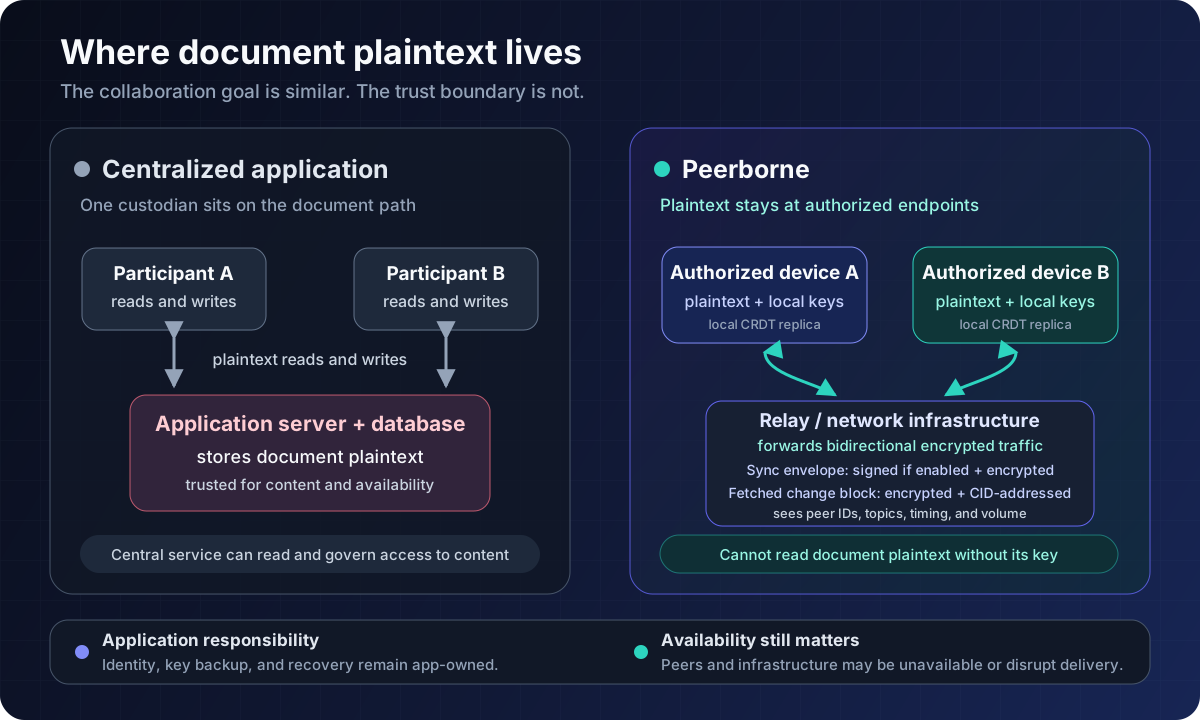
Section titled “When centralization is the downside”Peerborne removes the plaintext application database from the document path. It stores encrypted change payloads by CID and exchanges separate encrypted sync messages, signed when enabled, through network infrastructure. Relays do not receive document plaintext without the document key, but they still observe connection and traffic metadata and can drop, delay, or censor traffic. Peerborne changes the trust boundary; it does not eliminate infrastructure.
Fit diagram to page
Evidence boundary: This compares trust models, not availability or production readiness. Applications still own identity, key backup, and recovery; infrastructure may observe metadata or disrupt delivery, and durable restart recovery remains unproven.
Encryption is the default, not an add-on
Section titled “Encryption is the default, not an add-on”Stored change payloads and wire sync envelopes are encrypted with the document
key (AES-GCM by default). By default (enableSigning: true), the complete
outgoing sync message is also signed with the writer’s identity before it is
encrypted. The stored CID-addressed block is a separate encrypted artifact and
does not carry its own writer signature or ACL decision. Relays, bootstrap
nodes, and remote storage handle ciphertext rather than document plaintext.
Encryption remains on whether signing is enabled or not; Peerborne does not
intentionally transmit unencrypted document content.
Composable, not monolithic
Section titled “Composable, not monolithic”Peerborne is not a single package. It is six libraries you compose:
| Package | Role |
|---|---|
@peerborne/core | Core: encryption, signing, ACL, storage, networking |
@peerborne/yjs | Yjs CRDT adapter |
@peerborne/automerge | Automerge CRDT adapter |
@peerborne/react | React hooks and bindings |
@peerborne/redux | Redux state management bindings |
@peerborne/index | Client-side search indexing |
Use only what you need. Compose the adapters, bindings, and indexing layers that fit your application.
CRDT adapters, not a CRDT library
Section titled “CRDT adapters, not a CRDT library”Peerborne does not implement its own CRDT. It adapts existing, well-tested CRDT libraries — Yjs and Automerge — wrapping them with encryption, signing, access control, and peer-to-peer transport. You get the battle-tested merge semantics of Yjs or Automerge combined with Peerborne’s security and networking model.
Open source from end to end
Section titled “Open source from end to end”All six packages are source workspaces in a single repository. You build from source, run the examples locally, and inspect every layer. There is no closed-source coordination service or proprietary sync server.
When to use Peerborne
Section titled “When to use Peerborne”Peerborne is a good fit for applications that need:
- Collaboration across independently operated peers that cannot appoint one trusted plaintext custodian
- Encrypted document exchange through infrastructure that should carry ciphertext only
- Local writes and CRDT merge semantics instead of synchronous transactions through one database
- Application-controlled identity, keys, relays, and storage
- Experiments with intermittent or user-operated networks, with the current restart and partition/rejoin limitations understood
Peerborne is not a good fit when:
- A trusted, highly available central database is acceptable—it will usually be simpler and more mature
- You want a managed backend service (Peerborne has no cloud offering)
- You need transactional constraints, globally exclusive claims, or authoritative server-side workflows
- You need sub-100ms multiplayer presence (CRDT conflict resolution is eventual, not real-time)
- You are building a simple single-user offline app (use IndexedDB directly)
- You need SQL queries or relational data (Peerborne exposes CRDT documents, not relational queries)
Current status
Section titled “Current status”Peerborne’s initial release is early-stage software. It is suitable for experiments, prototypes, and learning about local-first systems, not production deployment.
Current evidence includes:
- A signed, distinct-identity founder-plus-one invitation across a Circuit Relay and NAT boundary, followed by fresh edits in both directions
- Single-browser smoke tests for all four example applications, including the bounded Peerborne Note invitation UX
- Separate Docker-backed transport tests for discovery, GossipSub delivery, and NAT behavior
That evidence does not yet prove durable restart recovery, offline or multi-member invitations, automatic reconnect, or system-level partition/rejoin convergence.
See the feature audit for a detailed capability-to-evidence map, and the limitations page for a complete list of current gaps.
Next steps
Section titled “Next steps”- Try Peerborne Note — use the initial-release demo within its identity, relay, and recovery boundaries
- Quick start — build from source and run the examples
- Concepts — understand the architecture and design choices
- Invite a collaborator — the bounded online invitation flow
- Roadmap — what is being worked on next